
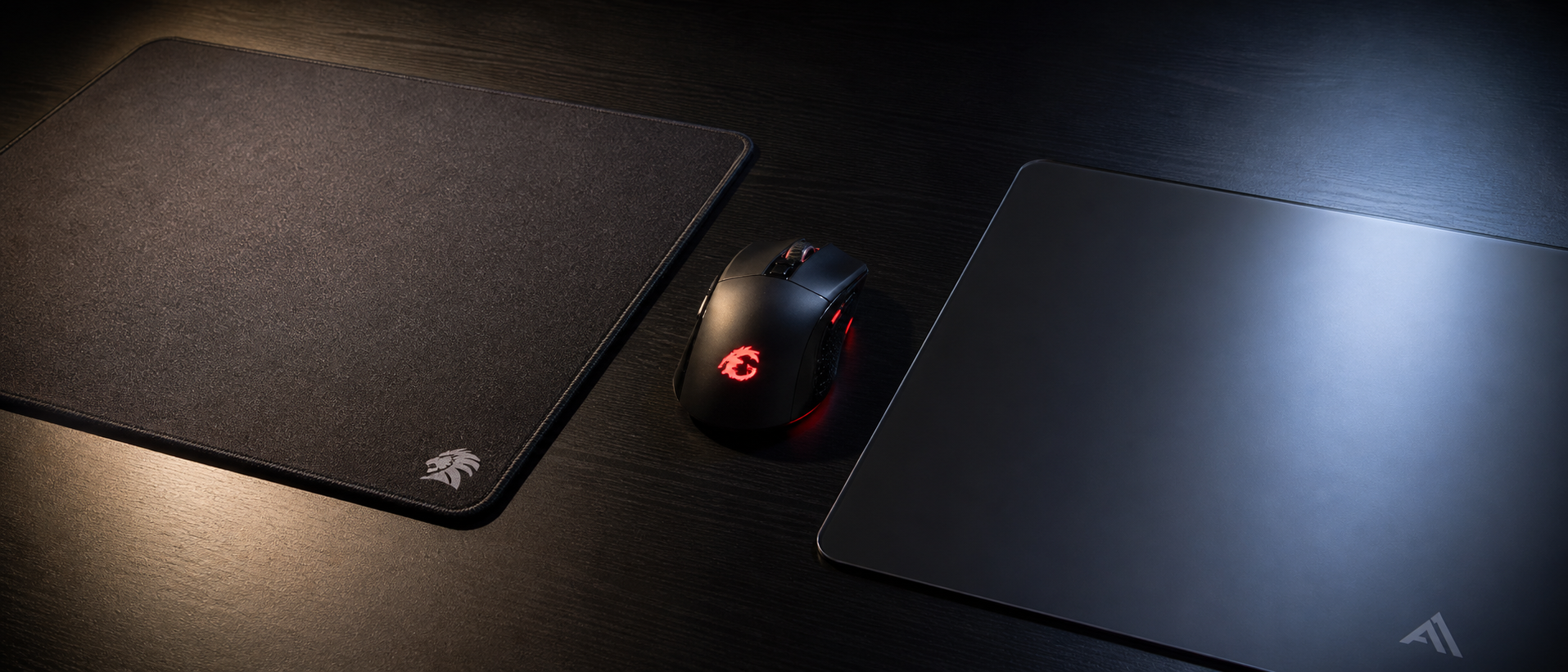
You've seen it in every gaming forum and Reddit thread: "Should I get a cloth pad or a hard pad?" The answer isn't as simple as picking a side. Your ideal mousepad depends on your aim style, the games you play, your mouse weight, and — if you're gaming in India — even the season.
In this guide, we'll break down the real differences between cloth and hard mousepads across every metric that matters for FPS gaming. No marketing fluff, just practical information from in-depth research into Indian conditions.
Understanding Mousepad Surfaces
Before we compare, let's define what we're actually talking about. "Cloth" and "hard" are umbrella terms that cover several sub-types:
Cloth Pads
Woven fabric surface (usually polyester) bonded to a rubber base. The weave tightness determines the speed/control balance. Tighter weave = smoother and faster. Looser weave = more texture and control. Examples: SteelSeries QcK, Logitech G240, Cosmic Byte Dwarf.
Hard Pads
Rigid surface made from plastic, aluminum, tempered glass, or polycarbonate. Some have micro-textured coatings. Minimal friction, maximum glide speed. Examples: Logitech G440, SteelSeries QcK Hard, Razer Acari.
Hybrid Pads
Hard top layer bonded to a soft foam or rubber base. Attempts to combine speed of hard pads with comfort of cloth. Examples: Razer Acari, Artisan Shidenkai, Xtrfy GP4 (hard). These sit between the two camps.
Most gamers in India start with cloth pads because they're cheaper, more available, and come in larger sizes. But that doesn't automatically make them the better choice for everyone. Let's dig into the specifics.
Glide Speed & Friction
This is the fundamental difference between the two types and the one that affects your gameplay most directly.
Cloth pads have higher static and kinetic friction. The woven fabric texture creates micro-resistance that slows your mouse down. This means:
- More force needed to initiate movement (higher static friction)
- Gradual deceleration when you stop moving (natural braking)
- Consistent resistance throughout the stroke
Hard pads have minimal friction. The smooth, rigid surface lets your mouse glide with almost zero resistance. This means:
- Minimal force to start moving (low static friction)
- Very little natural deceleration — you must actively stop the mouse
- Faster peak speed for the same arm effort
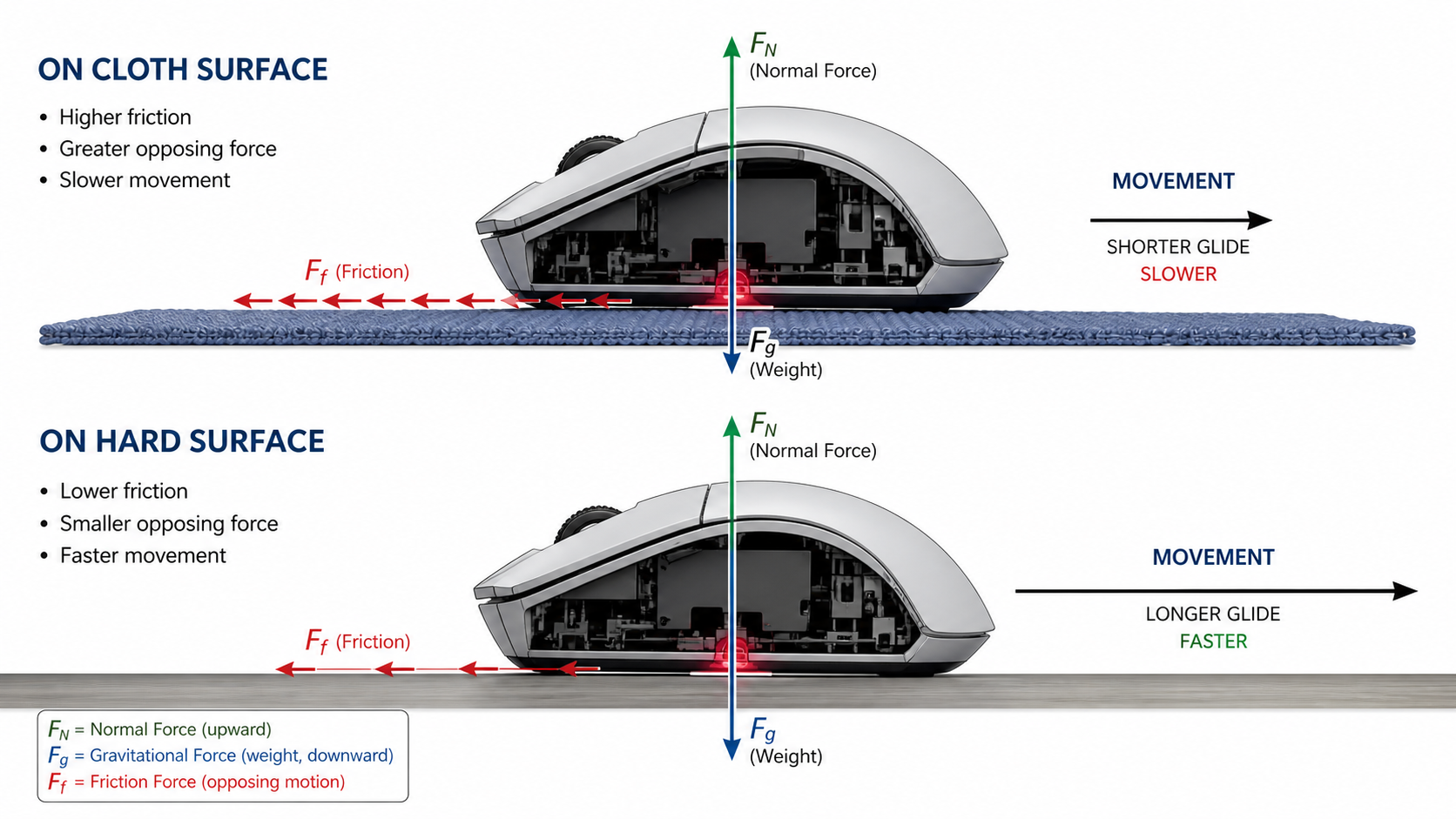
Think of it like driving on a gravel road (cloth) vs a polished highway (hard). The gravel gives you natural braking — you slow down the moment you ease off the accelerator. The highway requires you to actively brake. Neither is inherently better; they just demand different driving styles.
Key Insight: Static vs Dynamic Friction
The difference between static friction (force to START moving) and kinetic friction (force to KEEP moving) is much larger on cloth pads. This means there's a noticeable "breakaway" force when you start a flick. On hard pads, static and kinetic friction are nearly identical — movement feels seamless from start to finish. This affects micro-adjustments significantly.
Control vs Speed: What Matters for FPS
Here's where your game choice and aim style matter. Let's compare the two surfaces across key gaming scenarios:
| Metric | Cloth Pad | Hard Pad |
|---|---|---|
| Glide Speed | Moderate — depends on weave tightness | Very fast — near-frictionless |
| Control / Stopping Power | Excellent — natural braking | Low — must actively stop mouse |
| Micro-adjustments | Easier — texture provides feedback | Harder — mouse slides past targets |
| Fast Flicks | Requires more force to initiate | Effortless — low resistance |
| Noise Level | Silent — fabric absorbs sound | Audible scratching — can be annoying on mic |
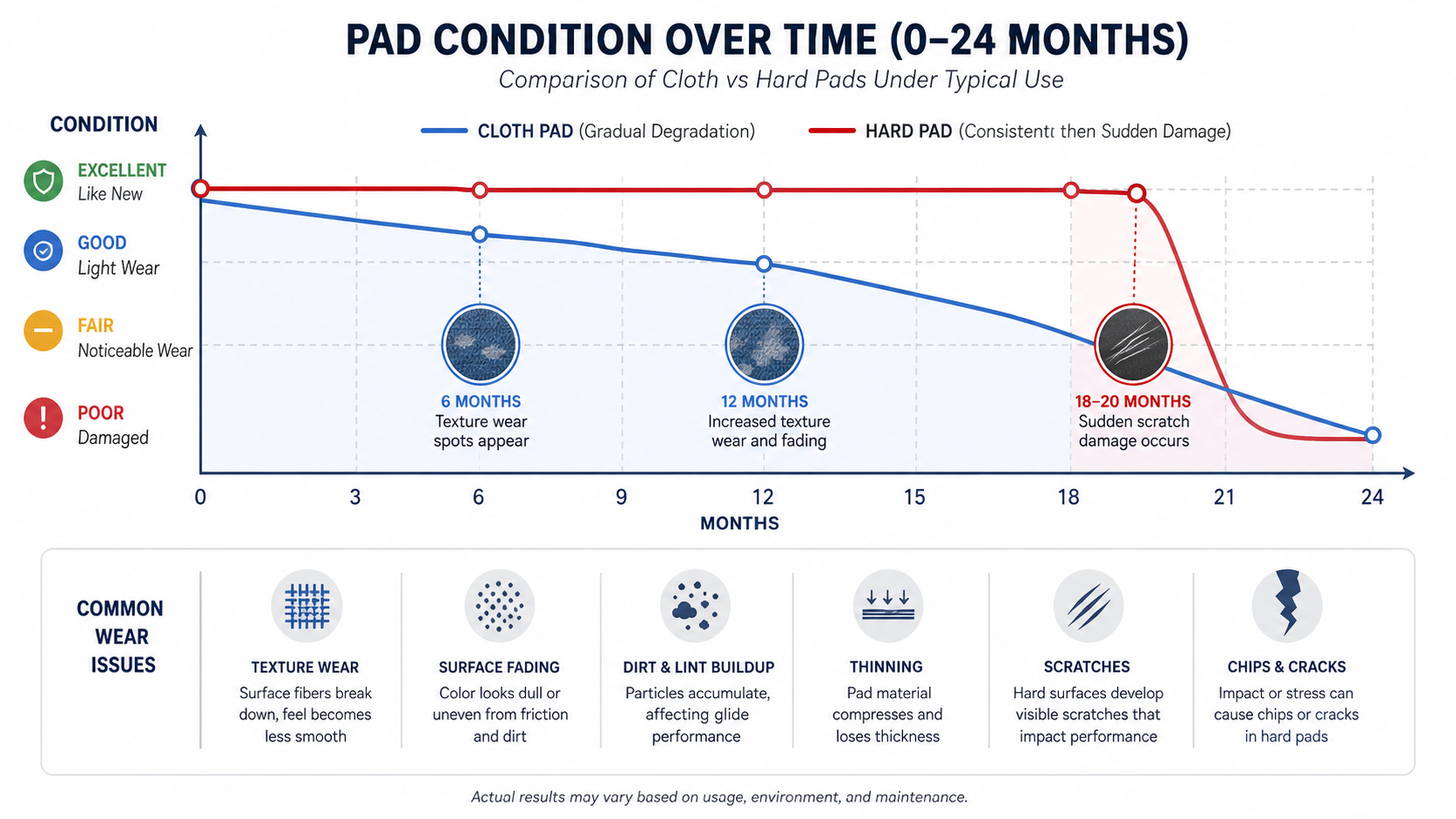
| Durability | 6-18 months before glide changes | 2-5 years — surface barely changes |
| Cleaning Ease | Requires washing and drying (30-60 min) | Quick wipe — 30 seconds |
| Price Range (India) | Rs 300 - Rs 3,500 | Rs 800 - Rs 5,000 |
For tactical shooters (Valorant, CS2) where crosshair placement and micro-adjustments are everything, cloth pads are overwhelmingly preferred by pros. The stopping power helps you land on the exact pixel you need.
For fast-paced shooters (Apex Legends, Overwatch 2) where rapid 180-degree flicks and tracking fast targets are common, some players prefer the low friction of hard pads. However, even in these games, the majority of pros still use cloth.
According to ProSettings.net data, roughly 85-90% of professional FPS players use cloth mousepads. The remaining 10-15% use hard or hybrid surfaces. This isn't conclusive proof that cloth is "better" — but it does tell you that control generally wins over speed at the highest level.
Durability & Wear
This is where hard pads have a decisive advantage — and it's often the reason people switch away from cloth.
Cloth pad degradation: Over time, the fabric weave compresses and collects dead skin, oil from your wrist, dust, and sweat. This creates "slow spots" — areas where your mouse drags noticeably more than the rest of the pad. Most cloth pads start feeling different within 4-6 months of daily use, and many need replacing within a year.
Hard pad durability: A quality hard pad (aluminum or glass) can last 3-5 years with virtually no change in surface properties. Plastic hard pads last 1-2 years. The surface doesn't absorb anything, doesn't compress, and doesn't develop slow spots.
The "Worn-In" Myth
Some players claim cloth pads get "better" with use as they break in. In reality, they're just getting used to the slower, degraded surface. A fresh pad always has more consistent friction across its entire area. If your aim feels off after months of use, replace the pad — don't blame your skill.
Cost per year: A budget cloth pad (Rs 400-600) replaced every 8 months costs you about Rs 600-900/year. A quality hard pad at Rs 2,000-3,000 lasting 3+ years costs Rs 700-1,000/year. The long-term economics are surprisingly similar — hard pads just frontload the cost.
Cleaning & Maintenance
Maintenance effort is dramatically different between the two types, and this matters a lot in India's dusty environment.
Cloth Pad Cleaning
Every 2-4 weeks for best performance
- Fill a basin with lukewarm water (not hot — it damages the rubber base)
- Add a small amount of mild soap or hand wash (no detergent powder)
- Submerge the pad and gently scrub with a soft sponge in circular motions
- Focus on areas where your wrist rests — that's where oil builds up fastest
- Rinse thoroughly under running water until no soap remains
- Squeeze gently (don't wring!) and lay flat to air dry — takes 4-8 hours
- Never use a hair dryer or direct sunlight — both damage the rubber base
Hard Pad Cleaning
Quick wipe every 2-3 days
- Wipe with a slightly damp microfiber cloth
- For stubborn grime, use a tiny bit of isopropyl alcohol (70%)
- Dry immediately with a clean cloth — takes 10 seconds
- That's it. You're done.
The maintenance difference is massive. If you're someone who hates cleaning routines or tends to neglect gear maintenance, a hard pad gives you more consistent performance with minimal effort. Cloth pads reward discipline — clean them regularly, and they perform great. Neglect them, and the glide deteriorates rapidly.
Climate Considerations (India)
This section exists because most mousepad guides are written by people in air-conditioned offices in Europe or the US. Indian gaming conditions are genuinely different, and the climate impacts your mousepad choice significantly.
Monsoon & Humidity (June-September)
Relative humidity in Mumbai, Chennai, Kolkata, and coastal cities regularly hits 80-95% during monsoon. This is brutal for cloth pads:
- Moisture absorption: Cloth fibers absorb humidity from the air, making the pad slightly damp to touch
- Increased friction: Damp cloth = dramatically more resistance. Your mouse feels like it's dragging through mud
- Inconsistent glide: Different areas of the pad dry at different rates, creating unpredictable spots
- Odor and mildew: In extreme cases, cloth pads stored in non-AC rooms develop a musty smell
- Sweat factor: Your wrist sweats more, adding to the moisture problem on the pad surface
Dust & Particulate Matter
Indian cities have significantly higher dust levels than Western countries. Delhi, Jaipur, and other North Indian cities are especially dusty:
- Cloth pads: Dust embeds deep into the fabric weave. Surface cleaning only removes the top layer. Over time, embedded dust acts like sandpaper on your mouse feet.
- Hard pads: Dust sits on top of the surface and wipes off instantly. No embedding. However, visible dust particles can create a "gritty" feel until cleaned.
Heat (March-June)
Indian summers mean 35-45°C ambient temperatures in many regions. Effects on mousepads:
- Cloth pads: Rubber base can become slightly soft/sticky in extreme heat. Wrist sweat soaks the fabric faster.
- Hard pads: May feel warm to touch initially but don't change performance. Aluminum pads can actually feel hot in direct sunlight.
- Both: Higher sweat output means faster grime buildup regardless of pad type.
India-Specific Recommendation
If you game without air conditioning in a coastal or high-humidity city, a hard pad or hybrid pad gives you dramatically more consistent performance year-round. If you have AC and game in a controlled environment, cloth works perfectly fine regardless of season. The AC removes the humidity advantage that hard pads have.
Impact on Mouse Feet (Skates)
Your mouse glides on small PTFE (Teflon) pads called skates or feet. The mousepad surface directly affects how quickly these wear down — and worn skates change your glide feeling completely.
Cloth Pads: Gentle on Skates
Fabric is soft and causes minimal abrasion. PTFE skates last 8-14 months with daily use on cloth. The soft surface also means cheaper, thinner skates work perfectly fine.
Hard Pads: Aggressive on Skates
Hard surfaces abrade PTFE much faster. Expect 3-6 months before skates need replacing. Glass and ceramic surfaces are the worst offenders. You'll also want thicker, higher-quality skates (like Corepadz or Tiger Arc) to compensate.
Replacement skates cost Rs 200-600 depending on your mouse model and brand. If you're using a hard pad and replacing skates every 4 months, that adds Rs 600-1,800/year to your total cost of ownership. Factor this in when comparing prices.
One often-overlooked point: worn skates on a cloth pad create more friction, making your pad feel slower than it actually is. If your cloth pad feels "muddy" after 6+ months, check your skates before blaming the pad. Sometimes Rs 300 in new skates restores the original glide feeling instantly.
Popular Options in India
Here are reliable, widely available options in both categories. We've prioritized pads you can actually buy on Amazon India or Flipkart without importing:
Best Cloth Pads Available in India
SteelSeries QcK Heavy (Large/XXL)
The industry standard. 6mm thickness, consistent weave, excellent control. Rs 1,500-2,500 depending on size. The one pad every FPS gamer should try at least once.
Logitech G240 / G640
G240 is a smaller control pad (Rs 800-1,200). G640 is a full-desk option with slightly faster glide. Both have consistent factory surfaces and good rubber bases.
Cosmic Byte Dwarf Control
Best budget option for Indian gamers. Rs 300-500 for a solid control pad. Stitched edges hold up well. Good for beginners who want to try a proper cloth pad without spending much.
Ant Esports MP290 / MP300
Another excellent budget pick. Rs 250-450. Available in multiple sizes. Stitched edges, decent thickness. Not as refined as SteelSeries but remarkable value for the price.
Best Hard Pads Available in India
Logitech G440
The most popular hard pad in India. Rs 1,500-2,000. Low-friction polymer surface with rubber base. Consistent glide. Not the fastest hard pad, but reliable and widely available.
SteelSeries QcK Hard
Rs 1,200-1,800. Micro-textured surface offers a balance between speed and some minimal control. Good size, doesn't move on desk. Pairs well with most gaming mice.
Razer Acari
Premium option at Rs 3,500-4,500 (when available). Ultra-low friction surface. One of the fastest pads on the market. Not for control players — strictly speed-focused.
Cosmic Byte Equinox
Budget hard pad at Rs 500-800. Aluminum surface, compact size. Not as refined as Logitech or SteelSeries, but a cheap way to test if you prefer hard pads before investing more.
Our suggestion for undecided Indian gamers: Start with a Cosmic Byte Dwarf or Ant Esports cloth pad (Rs 300-500). Use it for a month. If you find yourself fighting the friction — especially during monsoon season — grab a Logitech G440 and compare. You'll know within a week which type suits your aim style. Total investment: under Rs 2,500 to try both.
Frequently Asked Questions
Is a cloth or hard mousepad better for FPS gaming?
Do hard mousepads damage mouse feet faster?
Which mousepad type is better for Indian humid climate?
How often should I clean my mousepad?
Can I use a hard mousepad with a lightweight gaming mouse?
What is a hybrid mousepad and is it worth buying?
The Bottom Line
TL;DR
Cloth pads win for control and precision aiming — which is why 85%+ of FPS pros use them. They're cheaper, quieter, gentler on mouse feet, and come in larger sizes. The trade-off: they degrade over time, absorb humidity, and need regular cleaning.
Hard pads win for speed, consistency, and low-maintenance durability. They're ideal for fast-paced gaming, wrist aimers, and anyone gaming in high-humidity Indian conditions without AC. The trade-off: less stopping power, faster skate wear, and higher upfront cost.
For most Indian FPS gamers: Start with a quality cloth pad (SteelSeries QcK or Logitech G240). If monsoon humidity ruins your experience or you prefer speed, switch to a Logitech G440. Don't overthink it — the best mousepad is the one that lets you forget it's there and focus on your aim.
And remember: a Rs 500 cloth pad on a clean desk in an AC room will outperform a Rs 4,000 hard pad covered in dust and crumbs. Maintenance matters more than the product itself.
Related Guides