
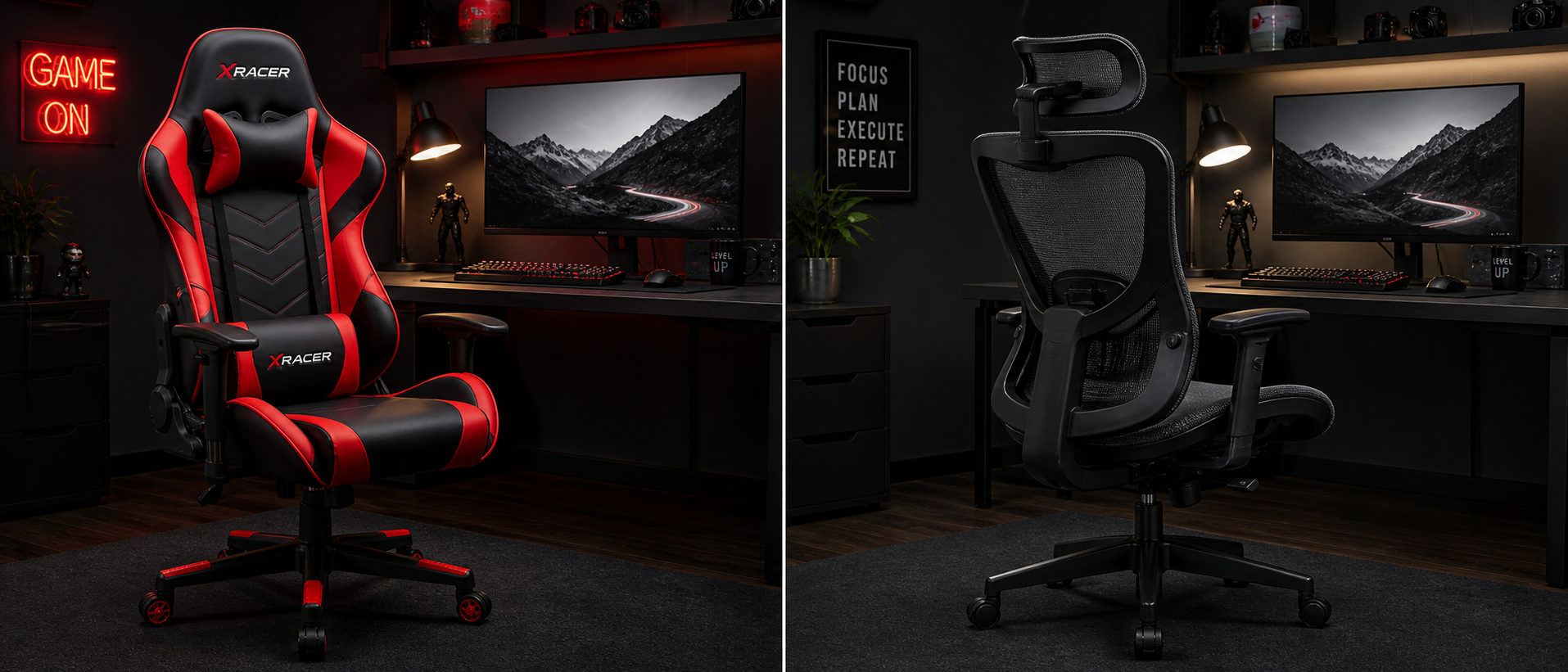
Walk into any gaming setup showcase on Instagram or YouTube India, and you'll see racing-style gaming chairs everywhere. They look aggressive, come in flashy red-and-black colorways, and scream "I'm a serious gamer." But walk into any corporate office or coworking space, and you'll see mesh office chairs — boring, grey, and unremarkable. Yet those boring chairs cost 2-3x more at the premium end.
So what gives? Is the gaming chair industry selling you overpriced aesthetics, or do office chairs charge a premium for their "ergonomic" label? We spent weeks testing both types, talked to physiotherapists, and dug into the Indian market to give you a straight answer. No sponsorships, no affiliate bias — just an honest comparison.
The Great Chair Debate
The gaming chair vs office chair debate isn't new, but it's become increasingly relevant in India since 2020. The WFH boom meant millions of people suddenly needed a proper chair — not a dining table chair held together with prayers. Many chose gaming chairs because they looked cool on Flipkart, were aggressively marketed by Indian gaming YouTubers, and seemed to offer "everything" — recline, armrests, lumbar pillow, headrest.
But here's the uncomfortable truth (pun intended): the best chair for you depends on what you actually do in it. If you game for 3 hours after work, your needs are different from someone coding 10 hours then gaming 4 more. Let's break this down category by category.
The Core Difference in One Line
Gaming chairs are designed to look like racing seats and prioritize recline + aesthetics. Office chairs are designed by ergonomics engineers and prioritize sustained posture support. Both can be comfortable — but they approach the problem from completely different angles.
Design Philosophy: Racing vs Ergonomic
Gaming chairs trace their lineage to DXRacer, a company that literally made racing car seats before pivoting to gaming in 2006. The bucket-seat shape, side bolsters, and aggressive recline all come from motorsport. The logic was: if it's good enough for a race car driver at 200 km/h, it's good enough for a gamer.
The problem? Race car drivers are strapped in with a 5-point harness, experiencing lateral G-forces. You're sitting at a desk. The side bolsters that hold a driver in place during a sharp turn just squeeze your hips for no reason. It's form over function — inherited design language that looks cool but serves no ergonomic purpose at a workstation.
Office chairs, particularly the ergonomic segment, evolved from decades of occupational health research. Companies like Herman Miller, Steelcase, and in India, Featherlite and Godrej Interio, design chairs based on how the human spine naturally curves. The goal: keep your pelvis tilted correctly, support your lumbar curve, and allow micro-movements throughout the day.
Gaming Chair Design Priority
Aesthetics first. Flat seat base, high side bolsters, fixed lumbar pillow, PU leather wrap, bold colorways. Designed to look impressive in photos and streams.
Office Chair Design Priority
Ergonomics first. Contoured seat, breathable mesh, adjustable lumbar depth, synchro-tilt mechanism. Designed to pass 8-hour sitting tests and reduce lower-back injury claims.
Ergonomics & Posture Support
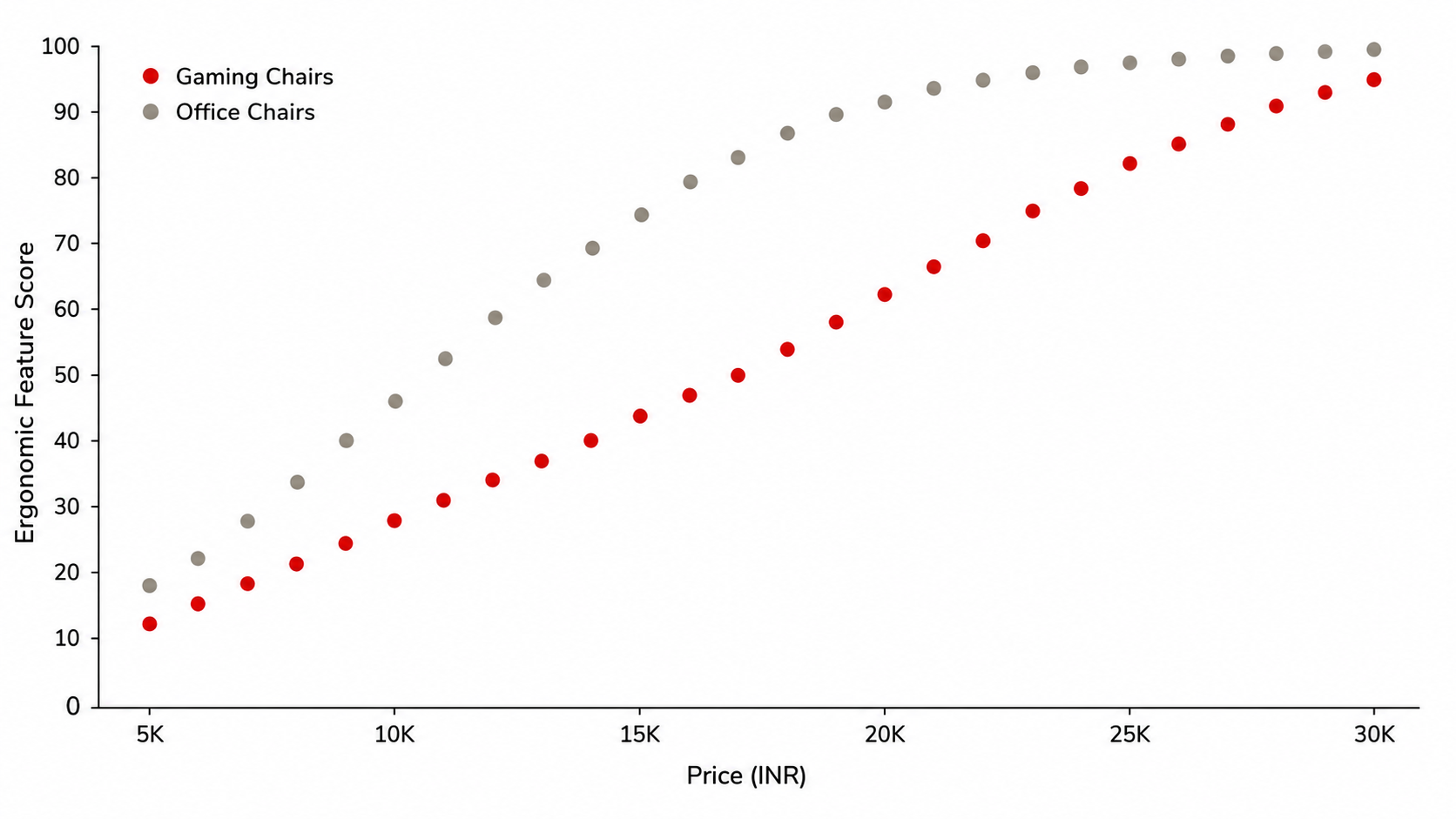
This is where office chairs pull decisively ahead — particularly in the Rs 15,000+ segment. Here's why:
Lumbar support is the single most important feature in any chair. Your lower back (lumbar spine) naturally curves inward. Sitting flattens that curve, which over time causes disc compression, pain, and long-term damage. A good chair actively maintains that natural curve.
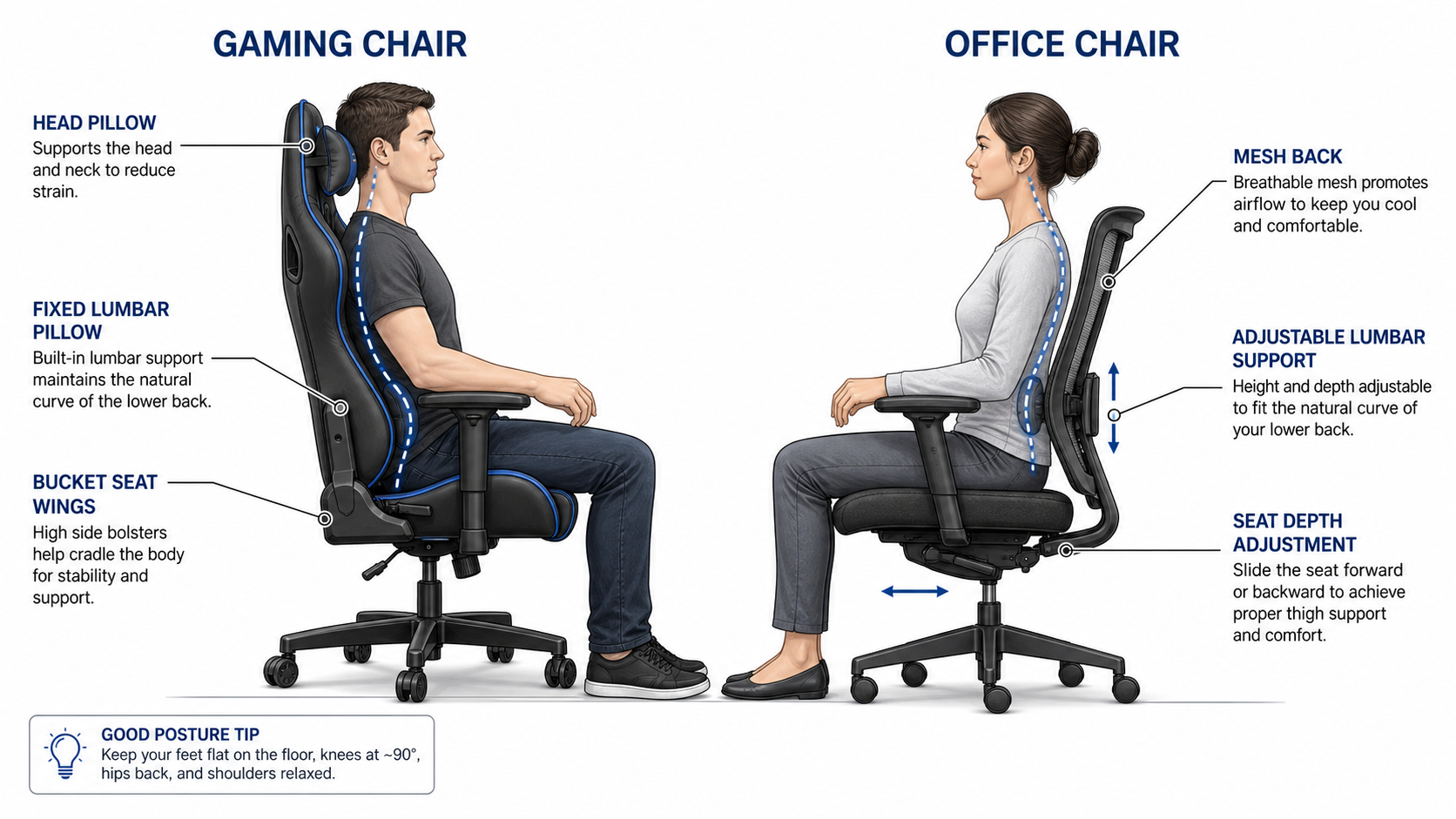
Gaming chairs use a removable lumbar pillow strapped to the backrest. It works — sort of. But it shifts when you move, doesn't adjust to your spine's specific curve, and many users end up removing it because it feels like a lump in the wrong spot. Some premium gaming chairs (Secretlab Titan, Rs 35,000+) now offer built-in adjustable lumbar, but that's the exception.
Office chairs in the Rs 15,000+ range typically have a built-in lumbar mechanism — either a depth-adjustable pad or a flexible backrest that conforms to your spine. Featherlite Optima, IKEA Markus, and Green Soul Jupiter all feature this. It stays in place, adjusts with a knob, and maintains support regardless of your sitting position.
The verdict on ergonomics: Office chairs win convincingly. Gaming chairs can be made more ergonomic with aftermarket lumbar supports, but out of the box, they're not designed with spinal health as the primary goal.
Comfort for 8+ Hour Sessions
Here's where things get nuanced. "Comfort" isn't just about ergonomics — it's also about how the chair feels to sit in, heat management, and whether you can shift positions easily.
Heat & Ventilation (Critical in India)
Most gaming chairs under Rs 20,000 use PU leather or faux leather. In Indian summers (35-45°C), this turns into a sweat trap within 2 hours. Your back and thighs stick to the surface. Mesh office chairs solve this entirely — air flows through, keeping you dry even without AC. This alone makes mesh office chairs superior for Indian WFH setups.
Seat Padding
Gaming chairs typically have thick foam padding that feels plush initially but compresses over months. Budget gaming chairs (under Rs 12K) often use low-density foam that flattens within 6-8 months. Office chairs use either high-density moulded foam or mesh seats that maintain their shape for years.
Recline & Lean-Back
Gaming chairs excel here. Most recline to 135-180°, letting you lean back for cutscenes, watching streams, or napping. Office chairs typically max out at 110-120°. If you like to lean way back while gaming with a controller, gaming chairs have a clear advantage.
For the Indian WFH gamer who works 8 hours then games 3-4 hours: a mesh office chair with decent recline (like the Green Soul Berlin at ~Rs 14,000) gives you the best of both worlds. You get breathability for those sweltering afternoon Zoom calls and enough lean-back for evening gaming sessions.
Build Quality & Materials
Let's talk about what you're actually getting for your money in terms of construction:
| Feature | Gaming Chair | Office Chair |
|---|---|---|
| Lumbar Support | Removable pillow (most); built-in on premium | Built-in adjustable (mid-range+) |
| Recline Range | 135° - 180° | 105° - 120° |
| Armrests | 2D-4D adjustable (padded) | Fixed or 2D (basic); 3D-4D on premium |
| Material | PU leather, faux leather, some fabric | Mesh, breathable fabric, moulded foam |
| Weight Capacity | 100-150 kg (varies by model) | 90-130 kg (mesh may sag at higher weights) |
| Warranty | 1-3 years (India avg.) | 3-5 years (premium: 10+ years) |
| Price Range (India) | Rs 7,000 - Rs 45,000 | Rs 5,000 - Rs 80,000+ |
Frame construction: Budget gaming chairs (Green Soul Monster, Da URBAN Throne) use thin-gauge steel frames with a plywood seat base. They creak under load and the gas lifts are often Class 2, meaning they may slowly sink over time. In comparison, office chairs like CELLBELL C104 or Featherlite Amaze use reinforced nylon/fiberglass bases with Class 3 or 4 gas lifts — quieter, more stable, and longer-lasting.
Upholstery: PU leather on budget gaming chairs is the biggest durability concern. In Indian humidity (especially coastal cities like Mumbai, Chennai, Kolkata), PU leather starts peeling within 18-24 months. The surface cracks, flakes appear on your clothes, and the chair looks terrible. Mesh doesn't have this problem — it might collect dust, but a quick vacuum cleans it up.
Adjustability Features
Gaming chairs have a reputation for being "fully adjustable," and to their credit, even budget gaming chairs offer features that basic office chairs don't:
Gaming Chairs Typically Include
Height adjustment, full recline (135-180°), tilt lock, 2D-4D armrests, removable lumbar & headrest pillows. Even a Rs 10,000 gaming chair usually has most of these.
Office Chairs Typically Include
Height adjustment, synchro-tilt mechanism, adjustable lumbar depth, seat depth slider (mid-range+), tension control. Premium models add headrest height/angle adjustment and 4D arms.
The key difference: gaming chairs give you more range (especially recline), while office chairs give you more precision (especially lumbar and seat depth). For someone who wants to game reclined at 150° with a controller, gaming chairs are genuinely better. For someone typing at a desk all day, the precise adjustments of an office chair matter more.
One underrated office chair feature: synchro-tilt. This mechanism lets the seat and backrest tilt together in a ratio (usually 1:2), keeping your feet flat on the ground while you lean back. Gaming chairs use a simple tilt-lock — either you're upright or fully reclined, with little in between. Synchro-tilt encourages micro-movements throughout the day, which reduces fatigue and improves circulation.
Durability & Lifespan
This is where the long-term value calculation gets interesting:
Gaming Chair Lifespan (Budget: Rs 8-15K)
Expect 2-3 years before significant wear. PU leather peeling is the #1 failure mode. Foam flattens by year 2. Gas lift may start sinking. Armrest padding degrades. The chair technically still works but looks and feels terrible.
Office Chair Lifespan (Mid-range: Rs 12-25K)
5-8 years easily. Mesh doesn't peel or crack. Class 3/4 gas lifts hold up. Nylon bases resist corrosion. The main wear point is armrest padding and wheel quality — both cheaply replaceable. Premium models (Featherlite, Herman Miller) last 10-15 years.
Cost per year calculation: A Rs 12,000 gaming chair lasting 2.5 years = Rs 4,800/year. A Rs 18,000 office chair lasting 6 years = Rs 3,000/year. The office chair is actually cheaper in the long run, despite the higher upfront cost. This is the math most buyers don't do when they see the "value" of a budget gaming chair on Amazon.
Pricing in India (2026)
Let's look at what you can actually buy at different budget tiers in the Indian market:
Under Rs 10,000
The budget battleground
Gaming Chairs
Green Soul Monster (Rs 9,499), Da URBAN Throne (Rs 8,999). Basic recline, PU leather, 1D armrests. Look good but won't last.
Office Chairs
CELLBELL C104 (Rs 6,999), IKEA Millberget (Rs 9,990), Green Soul Seoul (Rs 8,499). Mesh back, basic lumbar, better breathability.
Our pick: Office chair. At this budget, breathability and durability matter more than recline.
Rs 10,000 - 20,000
The sweet spot for most Indian buyers
Gaming Chairs
Green Soul Knight (Rs 14,999), Da URBAN Commander (Rs 16,999). Better foam, 3D armrests, fabric options available. Decent for 4-6 hour sessions.
Office Chairs
Green Soul Berlin (Rs 13,999), IKEA Markus (Rs 17,990), Featherlite Amaze (Rs 15,500). Adjustable lumbar, synchro-tilt, full mesh. Excellent for all-day use.
Our pick: Office chair for WFH primary. Gaming chair if aesthetics and recline are priorities.
Rs 20,000 and Above
Premium territory — real ergonomics begins
Gaming Chairs
Secretlab Titan (Rs 35,000+), noblechairs Hero (Rs 40,000+). Built-in lumbar, cold-cure foam, premium fabric. Actually ergonomic — but expensive for what they are.
Office Chairs
Featherlite Optima (Rs 22,000), Godrej Motion (Rs 25,000), Herman Miller Aeron (Rs 1,20,000+). True ergonomic engineering, 10+ year warranty, industry-leading support.
Our pick: Office chair dominates at this tier. You're paying for engineering, not branding.
Which Should You Buy?
Let's cut through the noise with specific recommendations based on your actual use case:
Pure Gaming (3-6 hrs/day)
Get a gaming chair if you want deep recline for controller gaming, like the racing aesthetic, and have AC in your room. Green Soul Knight or Da URBAN Commander in the Rs 12-17K range work well. Just accept the 2-3 year lifespan.
WFH + Gaming (8+ hrs/day)
Get an ergonomic office chair. You need sustained support for work hours, and your back will thank you. IKEA Markus, Green Soul Berlin, or Featherlite Amaze in the Rs 14-18K range. They have enough recline for casual gaming too.
Hot Climate, No AC
Get a full-mesh office chair, no question. Any PU leather chair will be unbearable in Indian summers without air conditioning. Even a basic Rs 8,000 mesh chair will be more comfortable than a Rs 15,000 PU leather gaming chair in May-June heat.
Tight Budget (Under Rs 10K)
Get a basic mesh office chair. At this price, gaming chairs sacrifice too much build quality to look cool. CELLBELL C104 or Green Soul Seoul give you better daily comfort than any gaming chair at the same price. Save the gaming chair fund for a better monitor instead.
Frequently Asked Questions
Are gaming chairs bad for your back?
Which is better for long gaming sessions — gaming chair or office chair?
Why are gaming chairs shaped like car seats?
Is a Rs 10,000 gaming chair worth it?
Do gaming chairs last longer than office chairs?
Can I use a gaming chair for office work from home?
The Bottom Line
Our Verdict
For most people in India — especially those working from home and gaming in the evening — an ergonomic office chair is the better investment. You get superior lumbar support, breathable mesh for our brutal summers, longer lifespan, and lower cost-per-year. The "boring" choice is actually the smarter one.
Gaming chairs aren't bad — they're just optimized for a different thing. If you game 3-4 hours in an air-conditioned room, want deep recline, and care about the aesthetics of your setup, a mid-range gaming chair (Rs 15-20K, fabric upholstery) is perfectly fine. Just don't buy one thinking it's "ergonomic" — the racing seat design was never about your spine.
The best chair is the one that supports your specific use case. But if you're sitting 8+ hours a day in Indian heat, spending Rs 10-20K, and want something that lasts — the mesh office chair wins. Period.