
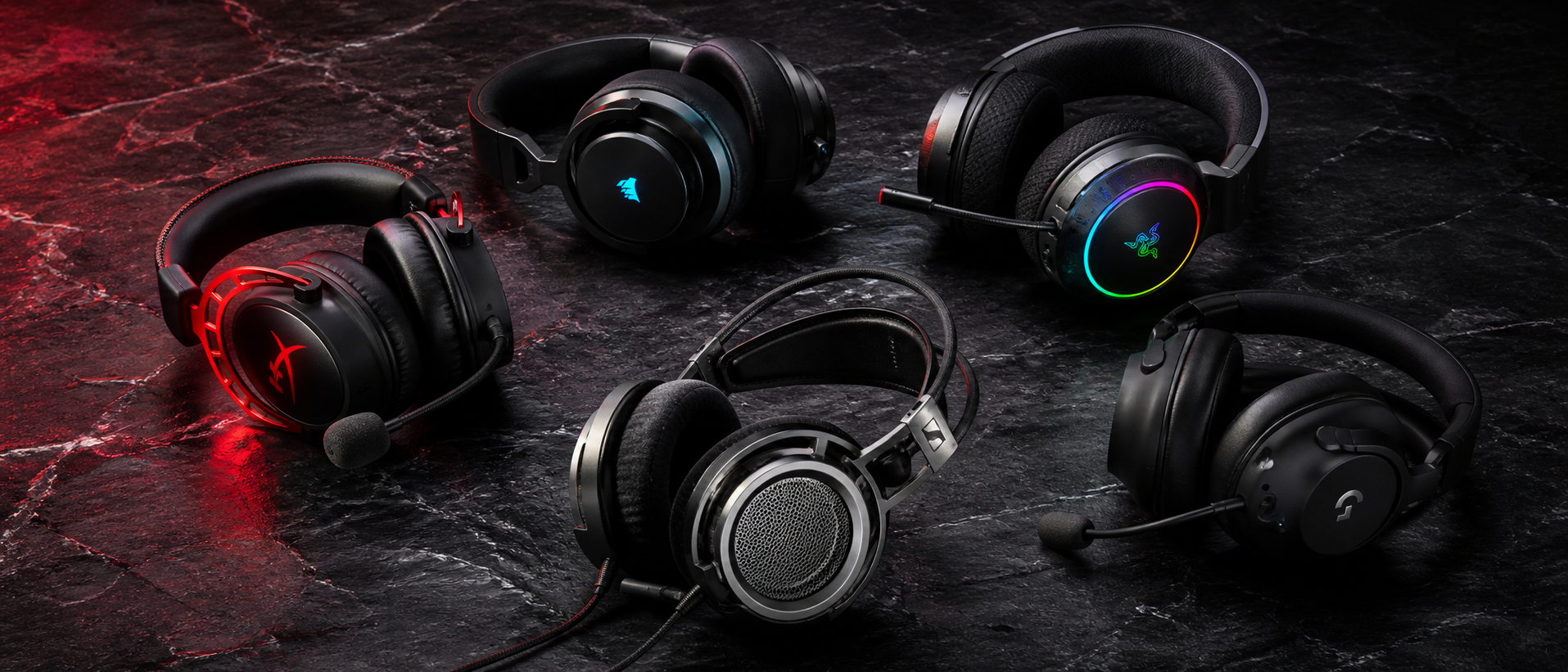
You're browsing Amazon India for a gaming headset. One costs Rs 1,200 and claims "studio-grade sound." Another at Rs 8,000 boasts "Hi-Res Audio certified." The Rs 15,000 one has RGB lighting on the ear cups (because apparently your ears need RGB). How do you actually tell what's good?
After researching dozens of headsets across every price range available in India, we've put together this comprehensive guide. Whether you're a competitive Valorant grinder, a casual story-gamer, or someone who just wants clear Discord calls without your mom's pressure cooker in the background — this guide will help you make the right choice.
What Actually Matters in a Gaming Headset
Before we dive into individual specs, here's the truth: most gaming headset marketing is noise (pun intended). The specs that actually affect your gaming experience boil down to a handful of factors. Let's rank them by real-world importance:
Comfort & Fit
If it hurts after an hour, nothing else matters. Especially crucial in India's hot climate where ear cups trap heat.
Sound Quality & Imaging
Can you tell where footsteps are coming from? Is the sound muddy or clear? Driver size and tuning matter here.
Microphone Quality
Your squad needs to hear your callouts, not your ceiling fan. Noise cancellation in the mic is essential for Indian homes.
Build Quality & Durability
Cheap plastic cracks. Thin cables fray. A headset that breaks in 6 months is no bargain regardless of price.
Connectivity (Wired vs Wireless)
Wired is cheaper and has zero latency. Wireless gives freedom but costs more and needs charging.
Notice what's not on the list? RGB lighting, "gaming" branding, and fancy frequency response numbers printed on the box. Those are marketing — not performance indicators.
Driver Size & Sound Quality
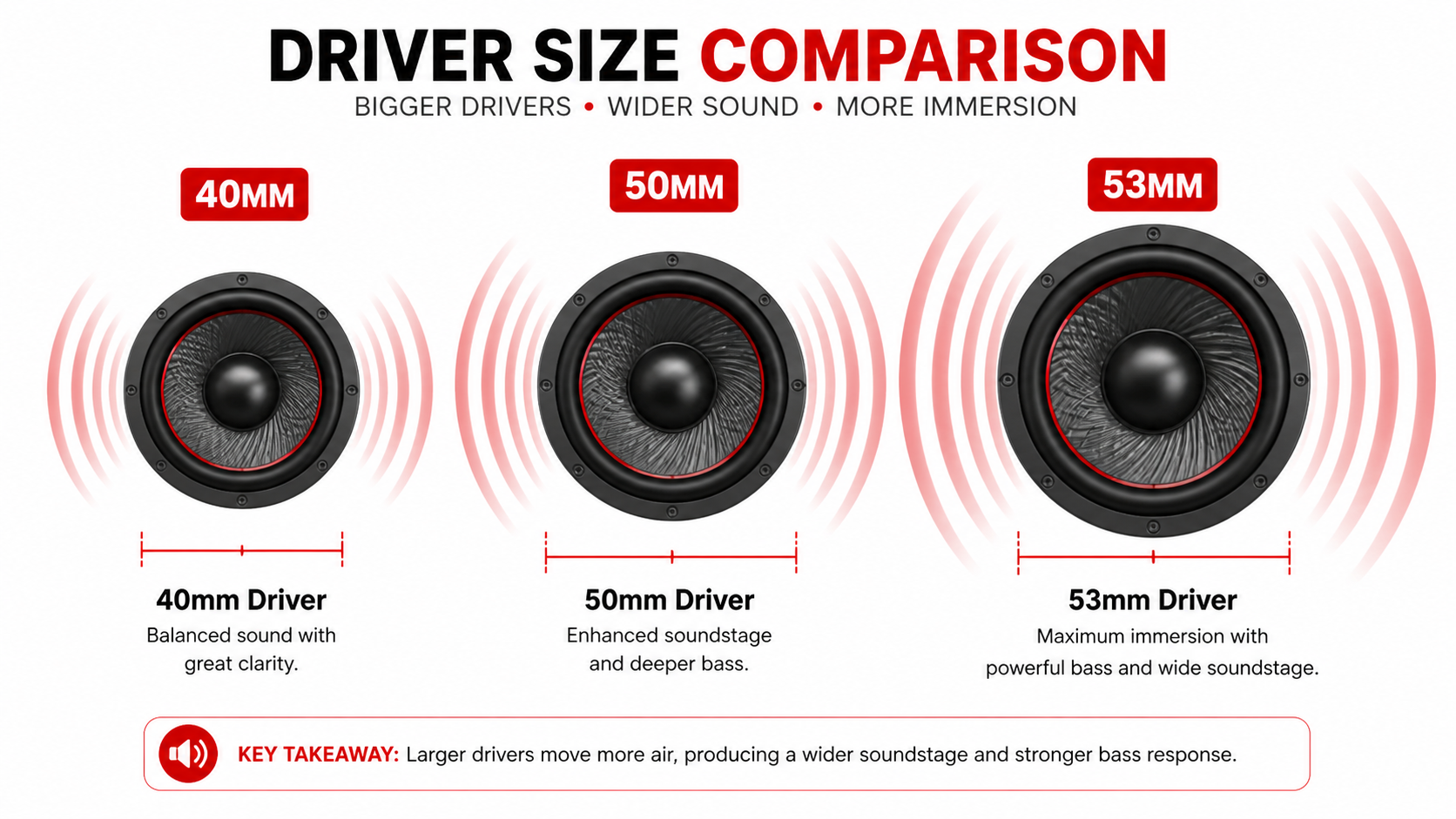
The driver is the speaker element inside each ear cup — it's the component that actually produces sound. Driver size is measured in millimeters (mm) and is one of the most-advertised specs on any headset box. But what does it actually mean for your gaming experience?
| Driver Size | Typical Use | Sound Character | Best For |
|---|---|---|---|
| 40mm | Compact/lightweight headsets | Tighter, focused sound; less bass extension | Competitive FPS (clarity over bass) |
| 50mm | Most gaming headsets | Balanced; good bass, clear mids | All-rounder (gaming + music + movies) |
| 53mm | Premium/audiophile headsets | Wide soundstage; deep bass, airy highs | Immersive single-player, music production |
Important: Size Isn't Everything
A well-tuned 40mm driver can sound significantly better than a poorly-tuned 50mm driver. Driver tuning — how the manufacturer voices the frequency response — matters more than raw millimeter size. The HyperX Cloud II uses 53mm drivers beautifully tuned for gaming. Some Rs 800 headsets slap in 50mm drivers with terrible tuning and call it "premium audio." Don't fall for size alone.
Frequency response is another spec you'll see (e.g., 20Hz - 20kHz). This is the range of frequencies the headset can reproduce. Human hearing tops out at roughly 20kHz, so anything advertising 10Hz-40kHz is mostly marketing. What matters is how flat and balanced the response is within the audible range — and you can't tell that from a spec sheet. You need to listen or read trusted reviews.
Open-Back vs Closed-Back
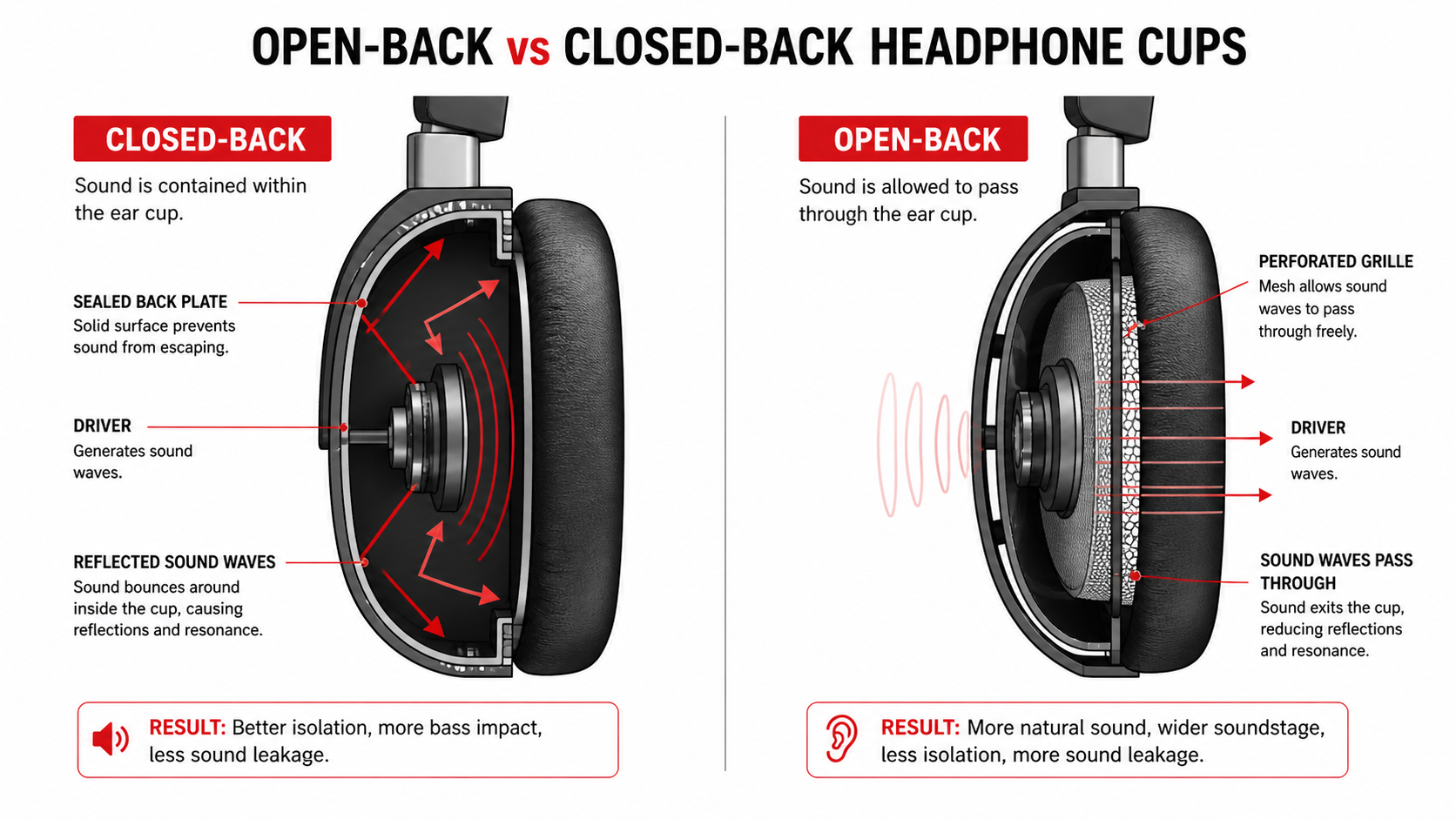
This is one of the most important decisions for Indian gamers, and it's rarely discussed in budget headset marketing. The "back" refers to the outer shell of the ear cup — whether it's sealed or has openings.
| Factor | Open-Back | Closed-Back |
|---|---|---|
| Soundstage | Wide, natural — sounds come from "around" you | Narrower — sound feels "inside your head" |
| Noise Isolation | None — you hear everything around you | Good — blocks external noise |
| Sound Leakage | High — people nearby can hear your audio | Minimal — your audio stays private |
| Heat/Comfort | Excellent — air flows freely, less sweat | Can get hot — sealed cups trap heat |
| Bass Response | Lighter — bass escapes through openings | Stronger — sealed chamber amplifies low-end |
| Price (India) | Typically Rs 5,000+ for decent options | Available from Rs 1,000 upwards |
For most Indian gamers, closed-back is the practical choice. Here's why: Indian homes are rarely quiet. Between family members, street noise, pressure cookers, and that one uncle who calls at full volume on speaker — you need isolation. Open-back headsets sound amazing in a quiet room but are impractical in shared spaces.
That said, if you have a private room with good noise control and you value positional audio for competitive gaming, open-back headsets offer a genuinely wider soundstage that helps you pinpoint enemy positions more naturally. Options like the Beyerdynamic DT 990 Pro or Audio-Technica ATH-AD700X (both available in India around Rs 10,000-15,000) are excellent for this.
Wired vs Wireless
The eternal debate. In 2026, wireless technology has matured significantly — but wired still has its place, especially in India where budget matters. Let's compare honestly:
Wired (3.5mm or USB)
+ Zero latency — instant audio response
+ No charging needed — always ready to game
+ Lighter weight (no battery)
+ Cheaper — same sound quality at lower price
+ Universal compatibility (3.5mm works everywhere)
- Cable can snag, tangle, or restrict movement
- Cable wear is the most common failure point
Wireless (2.4GHz Dongle)
+ Freedom to move, lean back, grab snacks
+ Clean desk setup — no cable management needed
+ Modern 2.4GHz has sub-1ms latency (as good as wired)
- 30-50% more expensive than wired equivalents
- Heavier due to battery (280-370g vs 230-290g)
- Battery dies mid-session if you forget to charge
- Needs a USB port for the dongle
Avoid Bluetooth for Competitive Gaming
Bluetooth headsets (like most boAt and Sony consumer headphones) have 100-300ms latency — that's a noticeable delay between in-game action and what you hear. Fine for music and movies, terrible for FPS gaming where a gunshot needs to reach your ears instantly. Always look for 2.4GHz wireless with a dedicated dongle for gaming. Bluetooth is a deal-breaker for competitive play.
Our recommendation for Indian gamers on a budget: Go wired. At the Rs 2,000-5,000 range, wired headsets offer dramatically better sound quality per rupee than wireless options. Only consider wireless if your budget is Rs 7,000+ and you genuinely need the freedom.
Microphone Quality
If you play any team-based game — Valorant, CS2, Apex Legends, PUBG Mobile (with a headset adapter), or even just Discord with friends — your microphone quality directly impacts your team's communication. Here's what to look for:
Boom Mic (Detachable/Flip-to-Mute)
Best clarity and noise rejection. Positioned right in front of your mouth. Most gaming headsets above Rs 2,000 have this. Look for flip-to-mute — incredibly handy when mom calls for dinner.
Inline Mic (On the Cable)
Picks up more background noise since it's farther from your mouth. Fine for casual chat but your teammates will hear your keyboard, fan, and TV. Common on budget headsets under Rs 1,500.
Retractable/Hidden Mic
Tucks into the ear cup when not in use. Convenient and clean-looking, but usually smaller capsule = slightly lower voice quality. Found on mid-range headsets like the Corsair HS65.
Noise cancellation on the mic is arguably the most important feature for Indian gamers. Look for headsets that specifically mention "noise-cancelling microphone" or "environmental noise rejection." This uses software or hardware to filter out background sounds — ceiling fans, traffic, family conversations — so only your voice comes through clearly.
Top performers in mic noise cancellation in India: HyperX Cloud III (excellent at every price point), JBL Quantum 350 (solid noise rejection), and Corsair HS80 (AI-powered noise removal via iCUE software). If you game in a shared room, prioritize this over almost every other feature.
Comfort & Fit for Long Sessions
India-specific factor number one: heat. Gaming sessions during summer with closed-back headsets and leather/pleather ear pads become a sweaty nightmare. Here's what affects comfort:
Ear Pad Material
Velour/Fabric: Breathable, stays cool, absorbs less sweat. Best for Indian climate. Found on HyperX Cloud series and most premium headsets. Downside: absorbs oils over time and needs replacement every 1-2 years.
Leather/Protein Leather: Better noise isolation, easier to clean, but traps heat and makes your ears sweat within 30-60 minutes in a non-AC room. Common on budget headsets.
Mesh/Hybrid: Modern solution — breathable fabric on the contact surface with memory foam underneath. Best of both worlds. Found on Corsair HS65/HS80 and JBL Quantum 610.
Clamping Force
Too tight: Headaches after 1-2 hours. Common issue with budget headsets that use cheap plastic headbands with no adjustment range. If you wear glasses, tight clamp pressure on the frames is painful.
Too loose: Slides around during intense gaming. Bass response also drops when there's no proper seal around your ears.
Just right: Firm but not pressing. Steel/aluminum headbands with memory foam padding (like HyperX, SteelSeries) tend to distribute weight best. Metal headbands also "break in" over time and conform to your head shape.
Weight
Under 270g: Featherlight. You forget you're wearing them. Examples: HyperX Cloud III (287g wired), Corsair HS65 (282g).
270-350g: Standard range. Comfortable for 3-4 hour sessions. Most mid-range headsets fall here.
Over 350g: Heavy. Neck fatigue in long sessions. Typical of wireless headsets with large batteries and premium builds. Look for well-padded headbands if going heavy.
Pro tip for Indian gamers: If you game without AC (many of us do), prioritize fabric/velour ear pads and lighter weight over everything else. An uncomfortable headset that you take off every 45 minutes is worse than a slightly lower-quality one you can wear for 4 hours straight. Some gamers in hot climates use a small desk fan pointed at their ears during sessions — it genuinely helps with closed-back headsets.
Virtual Surround Sound: Worth It?
Every gaming headset above Rs 3,000 advertises "7.1 surround sound" on the box. Let's demystify this:
True 7.1 Surround (Multiple Drivers)
Extremely rare. Some headsets like the older Razer Tiamat had multiple small drivers per ear cup. Results were mediocre — too many tiny drivers in a small space produce muddy, unfocused sound. This approach has largely been abandoned by major manufacturers.
Virtual 7.1 Surround (Software Processing)
Uses DSP algorithms (like Dolby Atmos, DTS Headphone:X, or Windows Sonic) to simulate directional audio through regular stereo drivers. This is what 99% of "7.1 headsets" actually use. Quality varies wildly by implementation.
The honest truth: Many competitive gamers disable virtual surround and play in pure stereo. Why? Because stereo gives you clean, unprocessed positional audio that your brain is already wired to interpret through subtle timing and volume differences between left and right ears (called HRTF — Head-Related Transfer Function).
Virtual surround can make single-player games more immersive — explosions in movies feel more cinematic, ambient soundscapes in RPGs gain depth. But for competitive FPS where pinpointing footstep direction is life or death, many players find stereo more precise and consistent.
Our take: Don't pay extra specifically for "7.1 surround" — it's software that can be added via free tools like Windows Sonic anyway. If a headset has good stereo sound quality, you can always add virtual surround later. But you can't fix bad drivers with software.
Budget Guide for India
Here's what you can realistically expect at each price tier on Amazon India and Flipkart in 2026. We've accounted for typical sale prices and availability:
Under Rs 2,000 — Entry Level
Brands: Cosmic Byte, Redgear, Eksa, boAt Rockerz
Expect: Decent 40-50mm drivers, basic stereo sound, plastic build, pleather pads that get warm. Inline or fixed boom mic with mediocre noise cancellation.
Don't expect: Durability beyond 8-12 months, detachable cables, breathable pads, or good mic quality in noisy environments.
Best for: Casual gamers, first headset, tight budget. Good enough for PUBG Mobile, casual Valorant, and Discord with friends.
Rs 2,000 – 5,000 — Sweet Spot
Brands: HyperX Cloud Stinger 2, JBL Quantum 200/300, Corsair HS55
Expect: Noticeably better sound quality, reliable boom mics with decent noise rejection, comfortable memory foam padding, metal-reinforced headbands. Some models offer detachable mics and cables.
Don't expect: Wireless, premium materials everywhere, or audiophile-grade tuning. Build quality is solid but not tank-level.
Best for: Regular gamers who play 2-4 hours daily. This is where price-to-performance peaks in India. Competitive Valorant, CS2, and team-based games are perfectly served here.
Rs 5,000 – 10,000 — Premium Gaming
Brands: HyperX Cloud III, JBL Quantum 610, Corsair HS65/HS80, SteelSeries Arctis Nova 3
Expect: Excellent sound quality rivaling entry-level audiophile headphones. Comfortable for 4-6 hour sessions. Noise-cancelling mics that actually work. Some wireless options (2.4GHz). Software support for EQ tuning. Premium materials — aluminum, breathable mesh, memory foam.
Don't expect: Active noise cancellation (ANC), planar magnetic drivers, or boutique audiophile sound. Wireless options at this range have slightly lower battery life than flagships.
Best for: Serious gamers, content creators who need good mic quality, anyone who games 4+ hours daily and values comfort. Also great as all-purpose headphones for music and movies.
Quick Picks by Budget
Based on our research and community feedback, here are our top recommendations at each price point (prices reflect typical 2026 India pricing on Amazon/Flipkart):
| Budget | Our Pick | Why | Price |
|---|---|---|---|
| Under 2K | Eksa E900 Pro | Detachable mic, 7.1 USB adapter, surprisingly good sound for the price | ~Rs 1,600 |
| Rs 2-3K | HyperX Cloud Stinger 2 | Lightweight, comfortable for hours, HyperX sound quality at budget price | ~Rs 2,800 |
| Rs 3-5K | JBL Quantum 300 | JBL QuantumSURROUND, excellent bass, sturdy build, good mic | ~Rs 4,200 |
| Rs 5-7K | HyperX Cloud III | Best-in-class comfort and sound, angled 53mm drivers, incredible mic | ~Rs 6,500 |
| Rs 7-10K | Corsair HS80 RGB Wireless | Premium wireless, 50mm drivers, Dolby Atmos, 20hr battery, breathable pads | ~Rs 9,500 |
These picks balance sound quality, comfort, mic quality, build durability, and availability in India. Prices fluctuate — check during Amazon Great Indian Festival or Flipkart Big Billion Days for 20-40% discounts on all of these.
Frequently Asked Questions
What driver size is best for gaming headsets?
Is a wireless gaming headset worth it in 2026?
Are gaming headsets better than regular headphones for gaming?
Do I need 7.1 surround sound for gaming?
Which gaming headset brand is best in India?
How important is microphone quality in a gaming headset?
Can I use a gaming headset with my phone and PS5?
The Bottom Line
TL;DR
Choosing a gaming headset in India comes down to three priorities: comfort first (especially in our climate), sound quality second (can you hear footsteps clearly?), and mic quality third (can your team hear you over the background noise?).
The Rs 2,000-5,000 range offers the best value for most Indian gamers. The HyperX Cloud Stinger 2 or JBL Quantum 300 will serve you brilliantly for competitive gaming without breaking the bank. If you can stretch to Rs 6,000-7,000, the HyperX Cloud III is the single best all-rounder available in India right now.
Skip wireless unless your budget is Rs 7,000+. Ignore 7.1 surround marketing — stereo from good drivers is better than fake surround from bad ones. And for the love of all things gaming, prioritize fabric/mesh ear pads if you don't game in AC. Your ears will thank you during those summer clutch moments.
Remember: the best gaming headset is one you forget you're wearing because it's so comfortable, while still delivering crystal-clear audio that gives you a competitive edge. Don't get distracted by RGB, brand hype, or inflated spec numbers.
SOURCES & REFERENCES
Our recommendations are based on research, comparison, and analysis — we don’t physically test products. The technical claims on this page are backed by the standards bodies and published research below.
- 1.
Related Guides