
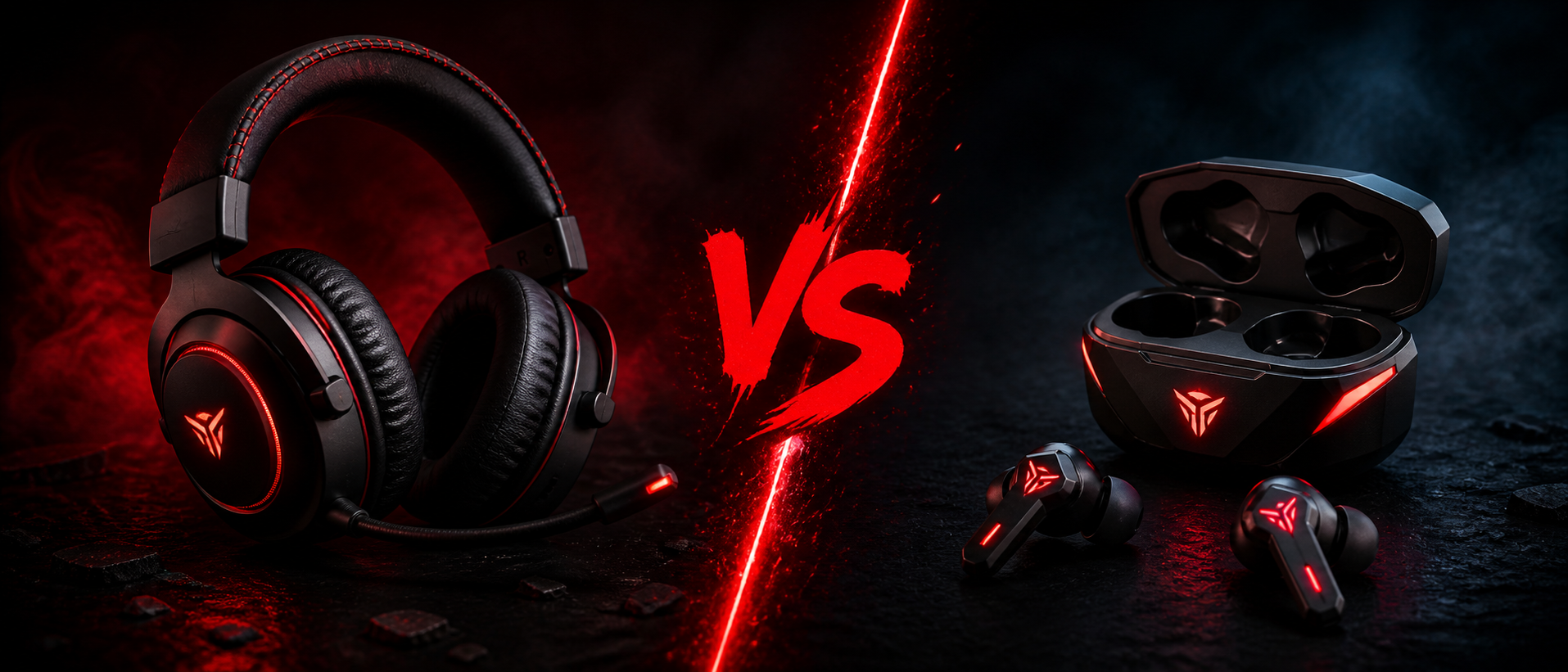
Walk into any gaming accessories section on Amazon India and you'll find two distinct camps: over-ear gaming headsets with RGB lighting and boom mics, and sleek TWS earbuds promising "gaming mode" with 40ms latency. Both cost around the same (Rs 1,500–5,000 for mid-range), but they serve very different use cases.
The truth is, neither is universally "better." Your ideal choice depends on what you play, where you play, how long you play, and honestly — how hot your room gets. In India, that last factor matters more than most international reviews will ever tell you. Let's break it down category by category.
The Core Differences
Before we dive deep into each factor, here's a high-level overview of how earbuds and headphones compare across the metrics that matter most to gamers:
| Factor | Earbuds / IEMs | Over-Ear Headphones |
|---|---|---|
| Sound Quality | Good detail, narrow soundstage | Wider soundstage, better imaging |
| Comfort (Long Sessions) | Lightweight, no heat buildup | Heavier, can cause sweating |
| Microphone | Inline or tiny built-in mic (average) | Boom mic (much better quality) |
| Latency (Wired) | Near-zero | Near-zero |
| Latency (Wireless) | 60–80ms (gaming mode) | 15–40ms (2.4GHz dongle) |
| Portability | Excellent | Bulky, not travel-friendly |
| Price (India) | Rs 500 – Rs 5,000 (sweet spot) | Rs 1,500 – Rs 10,000 (sweet spot) |
| Noise Isolation | Very good (seals ear canal) | Good (closed-back) to average (open-back) |
As you can see, each form factor has clear strengths. The "winner" depends entirely on your priorities. Let's examine each factor in detail.
Sound Quality & Soundstage
This is where headphones have traditionally dominated — and for good reason. Over-ear headphones have larger drivers (40–50mm) compared to earbuds (6–14mm), which gives them a natural advantage in producing fuller bass, wider soundstage, and more accurate spatial imaging.
Soundstage is critical for gaming. It's the perceived "width" of the audio — how well you can tell whether footsteps are coming from the left, right, above, or behind you. Open-back headphones like the Audio-Technica ATH-AD700X are legendary for this. Even closed-back gaming headsets like the HyperX Cloud II offer noticeably wider imaging than most earbuds.
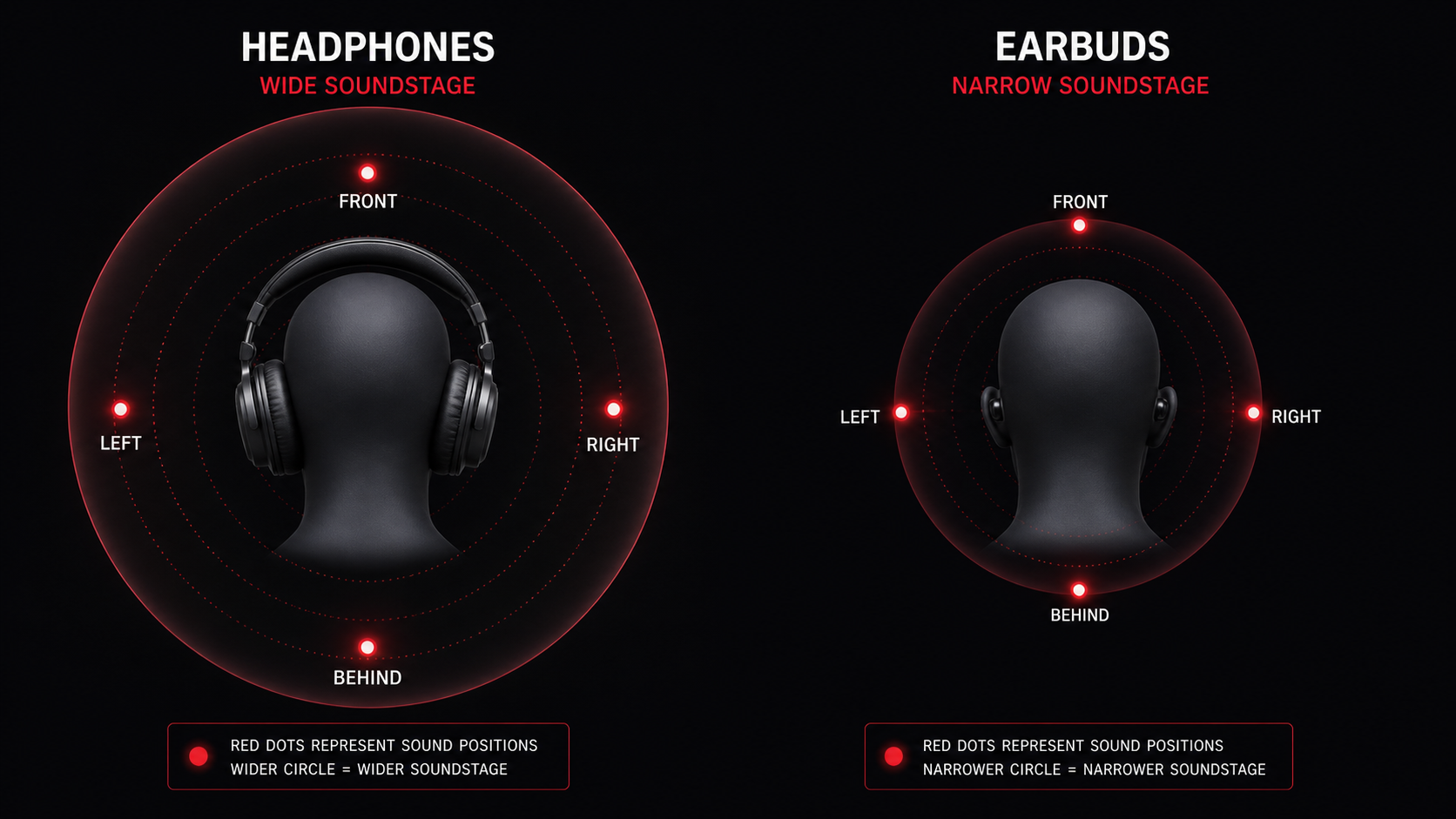
However, earbuds are catching up fast. Premium IEMs (in-ear monitors) with balanced armature drivers or hybrid setups can deliver stunning clarity and detail retrieval. Brands like KZ, Moondrop, and 7Hz sell IEMs under Rs 3,000 in India that rival headphones three times their price in pure audio quality — just not in soundstage width.
The Pro Player Exception
Here's something most people don't know: at major CS2 and Valorant LAN events, virtually every pro player uses IEMs (earbuds) for game audio — not headphones. Players like s1mple, ZywOo, and TenZ all use earbuds during matches. The over-ear headphones you see on their heads are just for noise isolation (playing white noise or acting as passive noise cancellers). If IEMs are good enough for million-dollar tournaments, they're good enough for your ranked games.
Verdict on sound: Headphones win on soundstage and spatial imaging for immersive single-player experiences. But for competitive gaming where you primarily need clear audio cues (footsteps, gunshots, ability sounds), a good pair of IEMs is more than sufficient. The isolation earbuds provide can actually help you focus better in noisy environments.
Comfort for Long Sessions
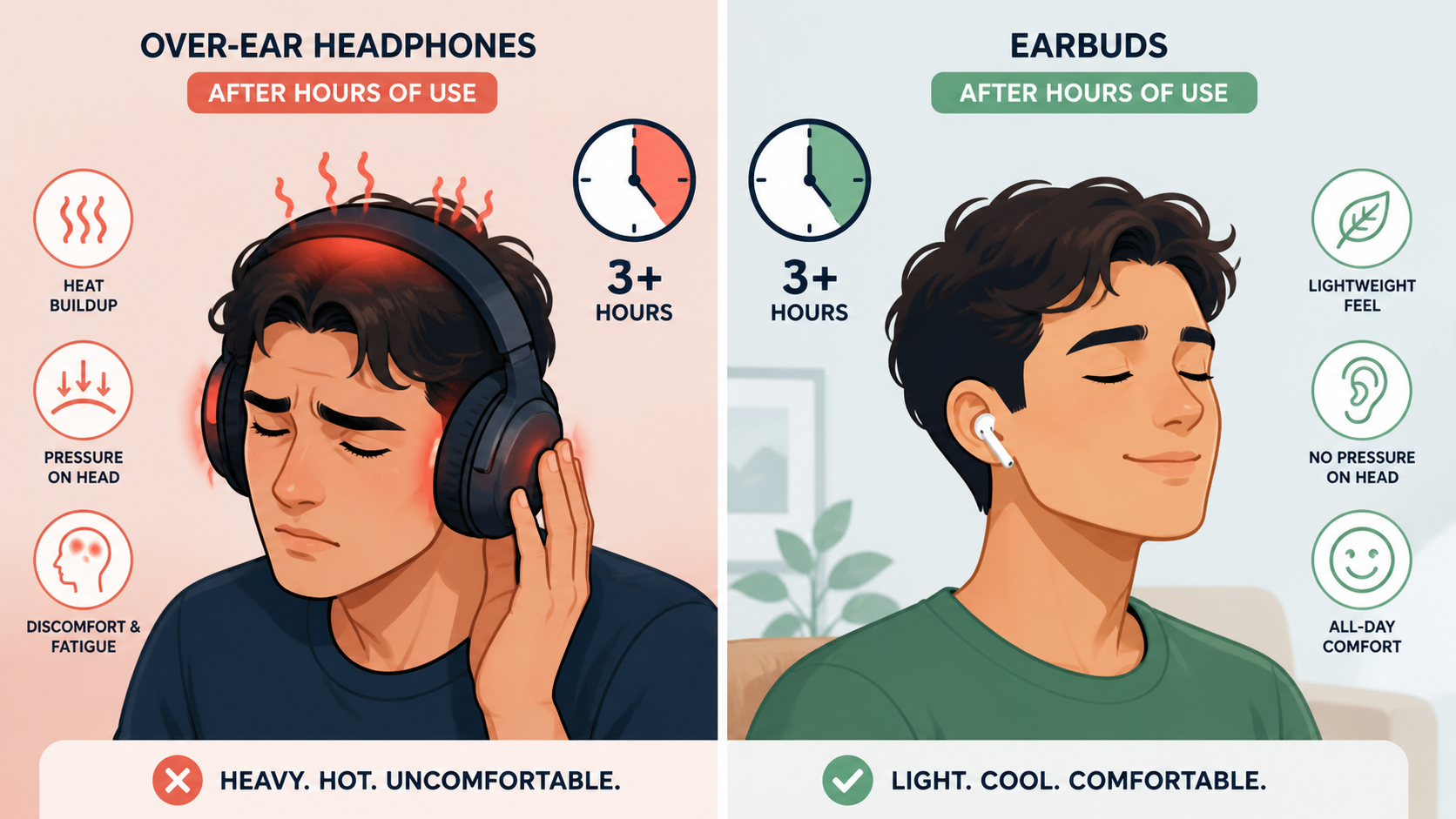
This is where the India factor comes in hard. Let's be honest about something international reviewers never mention: India is hot. Even with AC, most rooms hover around 24–28°C during summer gaming sessions. Over-ear headphones with pleather (synthetic leather) ear cups become sweat traps within 30–45 minutes.
Headphones: Comfort Profile
Heavier (250–350g), creates heat pocket around ears, clamping force can cause headaches after 2–3 hours. Velour or fabric pads help but trap dust. Good headband padding distributes weight well on premium models.
Earbuds: Comfort Profile
Ultra-light (5–7g per earbud), zero heat buildup, no pressure on head. However, silicone tips can cause ear canal fatigue after 3–4 hours. Some people find in-ear pressure uncomfortable. Foam tips improve comfort but wear out faster.
For Indian gamers playing 3–5 hour sessions (especially during those late-night ranked grinds), earbuds have a significant practical advantage. No sweaty ears, no headband dent in your hair, no neck strain from heavy headsets. If you're gaming in a non-AC room during May–September, headphones become genuinely unpleasant to wear.
That said, if you have a cool room and prefer the "cocooned" feeling of over-ear cups, premium headphones with breathable fabric pads (like the Corsair HS65 or HyperX Cloud III) can be comfortable for extended periods. Just know that budget gaming headsets (under Rs 2,000) almost always use cheap pleather that will make you sweat.
Latency & Connection
Latency — the delay between in-game action and when you hear it — matters immensely in competitive gaming. Even 100ms of audio delay can mean you hear a footstep too late to react. Here's how the options compare:
Wired (Earbuds or Headphones)
3.5mm jack or USB connection
Zero perceptible delay. Both wired earbuds and wired headphones perform identically here. This is the gold standard for competitive gaming and the reason wired audio isn't going anywhere. If you play Valorant, CS2, or any reaction-dependent game seriously, wired is the way to go regardless of form factor.
Wireless Headphones (2.4GHz Dongle)
HyperX Cloud Flight, SteelSeries Arctis, Logitech G Pro X
2.4GHz wireless headphones use a dedicated USB dongle that bypasses Bluetooth entirely. The result is near-wired latency that's imperceptible to most humans. This is excellent for gaming — you get wireless freedom with no meaningful audio delay. The downside: these only work with devices that have USB ports (PC, PS5).
TWS Earbuds (Bluetooth)
boAt Airdopes, OnePlus Buds, Realme Buds Air
Standard Bluetooth has noticeable delay that makes competitive gaming frustrating. However, most gaming-branded TWS earbuds now include a "low-latency" or "gaming" mode that drops to 60–80ms — usable for casual gaming and mobile titles. For BGMI on your phone, this is fine. For ranked Valorant on PC, you'll want wired.
Bottom line on latency: If you play wired, earbuds and headphones are equal. If you go wireless, headphones (with 2.4GHz dongles) have a significant latency advantage over Bluetooth TWS earbuds. For mobile gaming specifically, TWS earbuds with gaming mode are the practical choice since phones don't support USB dongles easily.
Microphone Comparison
If you're on Discord calls, streaming, or communicating with your squad in-game, mic quality matters. This is one area where headphones have a clear, almost unfair advantage.
Gaming Headset Microphones
Boom mics sit close to your mouth, pick up your voice clearly, and reject background noise effectively. Even budget gaming headsets (Rs 1,500+) have decent mics. Detachable boom mics are even better — flexible, positionable, and replaceable. For team communication, nothing beats a properly positioned boom mic.
Earbud Microphones
Inline mics on wired earbuds pick up cable noise and sit far from your mouth. TWS earbud mics are tiny and struggle in noisy environments — your teammates will hear your ceiling fan, your keyboard, and your family in the background. Passable for quick callouts, but not ideal for long Discord sessions or streaming.
The workaround: If you prefer earbuds for audio but need good mic quality, pair them with a separate desk microphone (even a Rs 800 Maono or Fifine USB mic will outperform any gaming headset boom mic). Many content creators and streamers use this combo — IEMs for monitoring + desk mic for voice. It's the best of both worlds if you have desk space.
Portability & Versatility
This one is straightforward: earbuds win by a massive margin.
A pair of TWS earbuds fits in your pocket. Literally. You can game on your phone during your commute, switch to a podcast, take a call, and put them back in the case — all with something smaller than a matchbox. Try doing that with a gaming headset that has a boom mic sticking out.
Earbuds: Use Cases Beyond Gaming
- Mobile gaming on the go (BGMI, COD Mobile, Genshin Impact)
- Music, podcasts, and YouTube during daily commute
- Gym and workouts (sweat-resistant TWS)
- Phone calls and video meetings
- Studying or working in libraries/cafes
Gaming headphones, on the other hand, are essentially single-purpose devices. They live on your desk. Their boom microphone makes them look ridiculous in public. Most aren't foldable. And if you're a college student in India sharing a hostel room, walking around with a full gaming headset just isn't practical for everyday audio needs.
If you can only buy ONE audio device that covers gaming AND daily life, earbuds offer dramatically more versatility per rupee.
Value for Money in India
Let's talk about the Indian market specifically, because pricing here tells a different story than international reviews suggest.
Budget Tier: Under Rs 2,000
Earbuds Options:
- - boAt Airdopes 131/141 (TWS, ~Rs 1,000)
- - Realme Buds Air 5 (TWS, ~Rs 1,500)
- - KZ ZSN Pro X (Wired IEM, ~Rs 1,200)
- - boAt BassHeads 100 (Wired, ~Rs 400)
Headphones Options:
- - Cosmic Byte H1 (Wired, ~Rs 600)
- - Redgear Shadow Helm (Wired, ~Rs 1,200)
- - Eksa E900 (Wired, ~Rs 1,800)
- - HyperX Cloud Stinger Core (Wired, ~Rs 1,900)
Assessment: At this price, wired IEMs like the KZ ZSN Pro X offer significantly better audio quality than any gaming headset. But if you need a mic for team chat, the HyperX Cloud Stinger Core is the budget king with its decent boom mic.
Mid-Range: Rs 2,000 – Rs 5,000
Earbuds Options:
- - OnePlus Buds Pro 2 (TWS, ~Rs 3,500)
- - Nothing Ear (2) (TWS, ~Rs 4,500)
- - Moondrop Chu II (Wired IEM, ~Rs 2,000)
- - 7Hz Salnotes Zero (Wired IEM, ~Rs 1,800)
Headphones Options:
- - HyperX Cloud II (Wired, ~Rs 4,500)
- - Corsair HS65 (Wired, ~Rs 3,800)
- - JBL Quantum 200 (Wired, ~Rs 3,000)
- - Logitech G435 (Wireless, ~Rs 4,500)
Assessment: This is the sweet spot where both categories shine. The HyperX Cloud II remains one of the best all-rounders for PC gaming. But if you game on both phone and PC, a premium TWS earbud + separate desk mic might give you more overall value.
Indian brands like boAt have made TWS earbuds incredibly accessible — you can get a pair with gaming mode for under Rs 1,000 during sales. No headphone brand matches that entry point for wireless gaming audio. However, remember that sub-Rs 1,500 TWS earbuds typically have mediocre audio quality and higher latency even in gaming mode.
Best Choice by Use Case
Rather than declaring one "winner," here's our recommendation based on how you actually game:
Competitive FPS on PC (Valorant, CS2, Apex)
If you need team comms, go with a headset (HyperX Cloud II, Corsair HS65). If you have a desk mic or don't chat much, wired IEMs give you better isolation and zero fatigue. Both deliver zero-latency audio that competitive gaming demands.
Mobile Gaming (BGMI, Free Fire, COD Mobile)
Headphones are overkill and impractical for mobile gaming. A good pair of gaming TWS earbuds (boAt Airdopes Pro, OnePlus Buds Pro) with low-latency mode is perfect. For competitive BGMI players, wired earbuds eliminate all latency concerns. The portability factor alone makes earbuds the obvious choice here.
Immersive Single-Player (RPGs, Horror, Adventure)
For games like Elden Ring, Resident Evil, or God of War where atmospheric audio is half the experience, the wide soundstage of over-ear headphones is unmatched. Open-back headphones create an almost speaker-like presentation that makes game worlds feel alive around you. Worth the sweat if immersion is your priority.
College Student / Budget Gamer
If you need one device that handles mobile gaming, music during commute, calls, and occasional PC gaming — TWS earbuds with gaming mode are the smart investment. You'll use them 10x more than a gaming headset that sits on your desk. Pair with a cheap wired backup for when battery dies mid-game.
Streamer / Content Creator
This is the pro setup. IEMs for monitoring game audio (no bleed into your mic), a dedicated condenser or dynamic USB mic for crystal-clear voice. No headphone creak picked up by the mic, no sweaty ears on camera. Many Indian streamers have switched to this combo.
Frequently Asked Questions
Are earbuds good enough for competitive gaming?
Do headphones have better sound quality than earbuds for gaming?
Which is better for mobile gaming — earbuds or headphones?
Do wireless earbuds have too much latency for gaming?
Why do pro gamers wear earbuds under headphones at tournaments?
Are earbuds better than headphones in hot Indian summers?
The Bottom Line
Our Verdict
There's no single "better" option — it depends entirely on your gaming scenario. But here's the honest truth for most Indian gamers: earbuds offer more value per rupee when you factor in versatility, comfort in our climate, and the reality that most of us game on both phone and PC.
Choose headphones if: You primarily game on PC, need team comms without a separate mic, play immersive single-player titles, and have a cool/AC room. A wired gaming headset like the HyperX Cloud II remains the best all-in-one solution for dedicated PC gamers.
Choose earbuds if: You game on mobile and PC, want something portable for daily use beyond gaming, get sweaty ears easily, or are on a tight budget. A good pair of wired IEMs (Rs 1,500–3,000) will outperform most budget headsets in pure audio quality.
And remember — pro gamers worth millions use earbuds at tournaments. If IEMs are good enough for the BLAST Premier finals, they're good enough for your Diamond lobby. Stop overthinking it, pick what's comfortable, and focus on your gameplay.
SOURCES & REFERENCES
Our recommendations are based on research, comparison, and analysis — we don’t physically test products. The technical claims on this page are backed by the standards bodies and published research below.
- 1.
Related Guides
Best Gaming Earbuds Under Rs 2,000
Top budget picks with low-latency gaming modes
Best Gaming Earbuds Under Rs 5,000
Premium TWS and IEMs for serious mobile gamers
Best Gaming Headsets Under Rs 2,000
Budget over-ear headphones with boom mics
Are Earbuds Good for Gaming?
A deep dive into when earbuds beat headphones